GATE Specification
A web-readable version of the core specification. This page is the canonical HTML rendering of GATE's architecture, contracts, and conformance requirements.
Overview
GATE (Governed Agent Trust Environment) is a control-plane framework for trustworthy AI agents. It defines enforceable boundaries for tool execution and memory access, plus contracts, evidence models, and conformance checks to support audit, incident response, and safe scaling of autonomy.
v1.3 scope boundaries
v1.3 makes three previously-implicit assumptions explicit. They are normative scope statements for the framework, not new requirements on existing controls.
Enrolment assumption. GATE governs agents that are enrolled in the control plane. It does not substitute for network-level discovery of shadow or rogue agents. Discovery and enrol-or-terminate is the subject of C17 Agent Discovery and Shadow AI Detection.
Memory flow scope note. The Memory Gateway is an access-control and provenance boundary, not a data-quality boundary. Stale or low-confidence content can pass every Memory Gateway check. Retrieval-time minimum quality gates are the subject of C18 Data Quality Gates.
Drift vs adversarial assurance. C16 detects adversarial events. C19 Model Behaviour Monitoring detects gradual statistical drift against a signed baseline. These are different detection mechanisms and are emitted as distinct ledger event types. They must not be merged.
v1.4 output boundary
Output validation. v1.4 adds the twentieth control at the delivery boundary. C20 Agent-to-Human Output Validation classifies every final agent response before delivery (sensitivity tier, regulated category, confidence score) and enforces redaction, hold-for-review, and human-review obligations from a signed action matrix, with a fail-closed default at high_privilege tier. C20 is the per-response content signal; it is distinct from C13 (per-run intent) and C19 (aggregate drift) and the three are not merged.
Design Principles
These principles are normative for GATE implementations. They define what must be true for GATE to function as a control plane, independent of agent framework, cloud provider, or model vendor.
- Zero trust for agents: every agent instance has a unique workload identity; every action is authenticated and authorized.
- Deterministic boundaries: the model proposes; the control plane disposes. Side effects occur only via governed enforcement points.
- Defense in depth: no single mechanism (prompts, RBAC, logging) is assumed sufficient; controls compose.
- Separation of duties: agents do not enforce their own safety. Enforcement and evidence are externalized.
- Evidence-first operations: critical decisions produce verifiable evidence suitable for audit, replay, and post-incident analysis.
- Composability: controls are services and contracts that can be adopted incrementally and validated via conformance checks.
Threat Model
Agent systems expand the attack surface beyond classic application threats. Adversarial influence can enter through: user prompts (direct injection), retrieved content (indirect injection), tool outputs (malicious or compromised systems), long-lived memory poisoning, cross-agent manipulation, confused deputy attacks, extraction/probing, and cost/runaway loops.
- Craft inputs to override or subvert instructions (direct prompt injection).
- Embed malicious instructions in “trusted” data (indirect injection via web pages, PDFs, tickets, emails).
- Exploit ambiguity in natural-language tool protocols and weak schema validation.
- Take advantage of shared credentials or weak attribution to hide actions.
- Trigger runaway cost or operational damage via loops, recursion, or agent-to-agent cascades.
Reference Architecture
The GATE reference architecture externalizes enforcement and evidence. The agent runtime calls GATE enforcement points for all tool and memory operations. Evidence systems commit immutable records and replay traces.
Trust logical pipeline
Logical view of the governed execution boundary: tool and memory operations are mediated, and evidence is produced for every governed step.
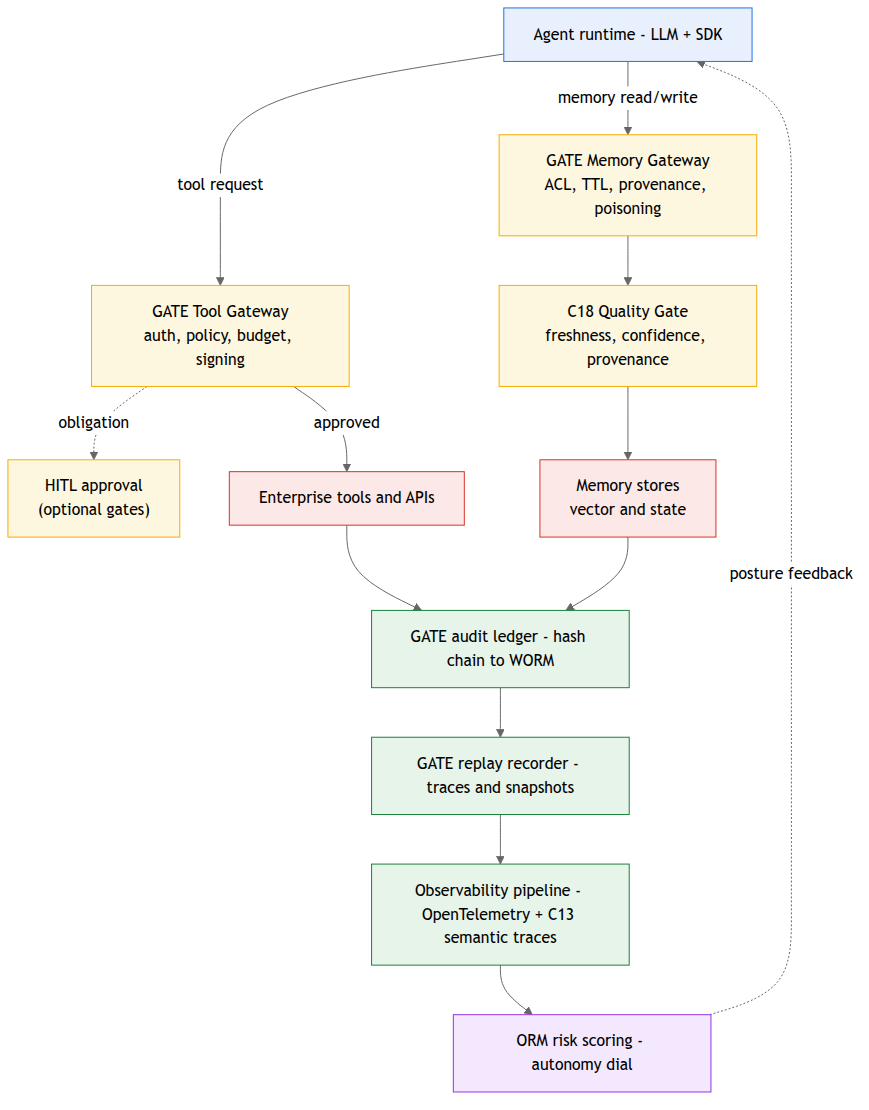
GATE logical architecture
Execution path (top) and supporting trust services (bottom). Trust services are bound to stages of execution and provide identity, audit, replay, memory governance, and observability with optional HITL and risk scoring.
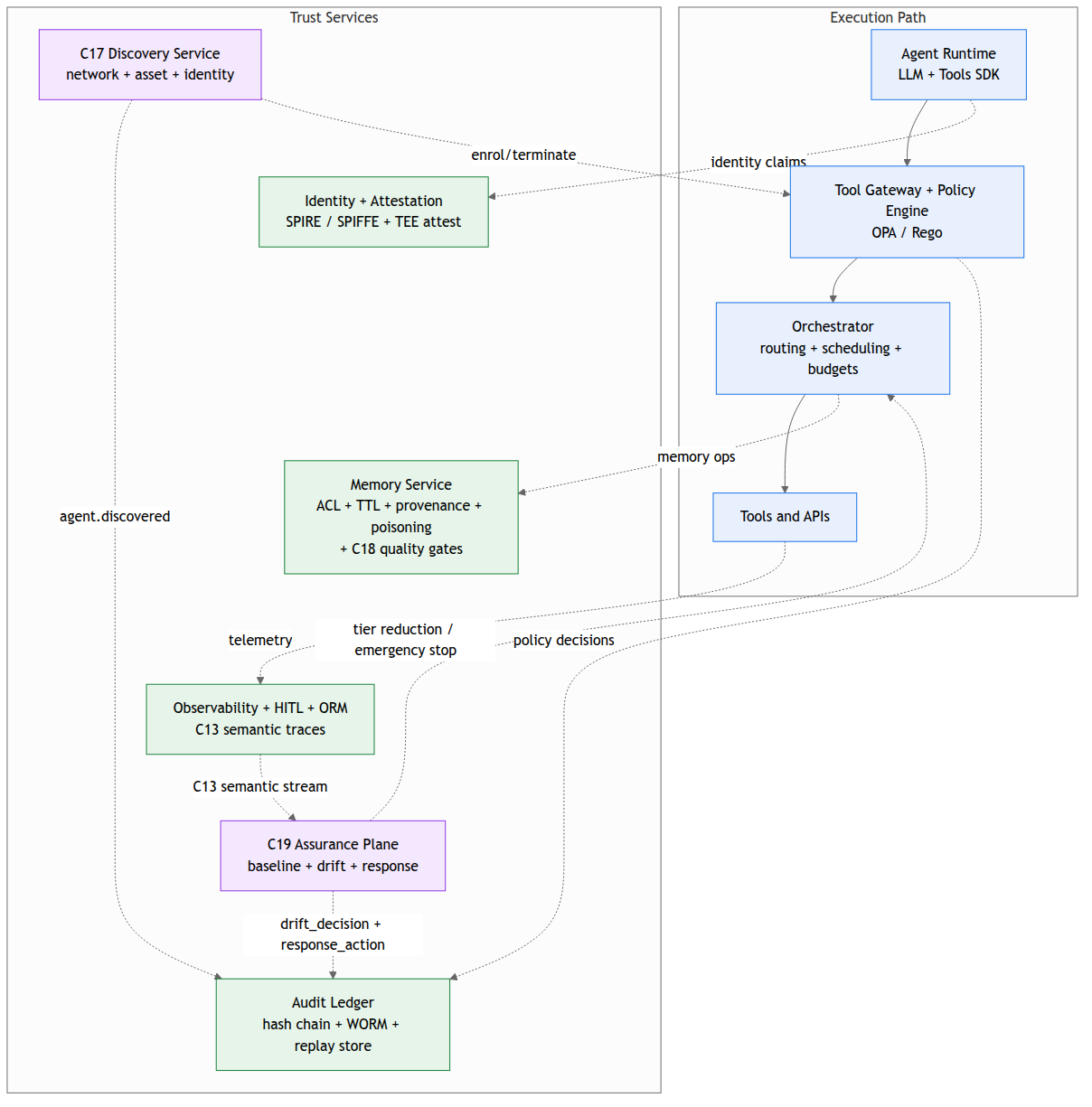
Component responsibilities
| Component | Primary responsibility | Evidence it must emit |
|---|---|---|
| Agent Runtime | LLM + SDK execution; must route all tool/memory operations via GATE. | Run identifiers + trace propagation (no direct evidence authority). |
| GATE Tool Gateway | Authenticate, evaluate policy, enforce schema + budgets + obligations before tool execution. | Policy decision record, tool invocation record, links to ledger + replay. |
| GATE Memory Gateway | Enforce retrieval/write ACLs, provenance, TTL, and poisoning controls for memory. | Memory access decision + provenance/TTL outcomes + evidence pointers. |
| Audit Ledger | Append-only, tamper-evident record of critical events with hash chaining. | Ledger commits with hash chain pointers and signatures. |
| Replay Recorder | Record snapshots and pinned bundles to reproduce runs at the governed boundary. | Replay trace steps referencing snapshots and bundle hashes. |
| Observability | Semantic tracing and correlation across runs, decisions, and evidence stores. | Traces with run_id/trace_id linked to evidence artifacts. |
| HITL (optional) | Human approval gates for high-risk actions. | Signed HITL decision record linked to blocked action. |
| Orchestration / ORM | Queue depth, concurrency, backpressure; adjust autonomy based on risk signals. | Orchestration decisions + risk scoring inputs/outputs (when used). |
Control Plane Contracts
GATE contracts define minimum interoperability between agent runtimes, enforcement points, and evidence systems. They are intended as a stable interface: implementers can swap components without breaking the evidence model.
- Versioned schemas: every contract has an explicit schema version and is backward-compatible within a major version.
- Global correlation: all records include stable IDs (run_id, trace_id, agent_instance_id, policy_hash).
- Integrity by default: hashes and signatures are first-class fields; no “best effort” integrity.
- Minimal disclosure: sensitive payloads should be minimized, encrypted, or referenced by pointers.
Contract schema excerpts (YAML)
These are the minimum contract shapes used by GATE to correlate identity, policy decisions, tool/memory operations, evidence, and replay. Replace or extend fields to match your implementation while preserving the correlation and integrity requirements.
ToolRequestEnvelope
schema_version: v1
event_type: GATE.tool.request
time: "2025-12-24T10:20:00Z"
run_id: uuid
trace_id: otel-trace-id
span_id: otel-span-id
tenant_id: tenant-123
environment: prod

agent:
  agent_instance_id: "spiffe://org/agent/planner#run-123"
  agent_name: planner
  agent_version: "2.1.0"
  identity:
    subject: "spiffe://org/agent/planner"
    attested: true
    claims:
      image_digest: "sha256:."
      config_hash: "sha256:."
      toolset_hash: "sha256:."

tool:
  name: crm.update_contact
  category: reversible_write
  risk_tier: medium
  idempotency_key: optional-stable-key

inputs:
  content_type: application/json
  payload:
    contact_id: "123"
    email: "new@example.com"

bundles:
  policy_bundle_hash: "sha256:."
  prompt_bundle_hash: "sha256:."
  tool_schema_hash: "sha256:."

hashes:
  request_hash: "sha256:."

context:
  orm_risk_score: 0.42
  budgets:
    tokens_remaining: 20000
    tool_calls_remaining: 120
    cost_usd_remaining: 18.50
  source_labels:
    - user_input
    - retrieved_doc
  approval:
    required: false
    approval_id: null
ToolResponseEnvelope
schema_version: v1
event_type: GATE.tool.response
time: "2025-12-24T10:20:01Z"
run_id: uuid
trace_id: otel-trace-id
span_id: otel-span-id
tenant_id: tenant-123
environment: prod

tool:
  name: crm.update_contact
  status: success
  duration_ms: 312

outputs:
  content_type: application/json
  payload_redacted:
    updated: true
  snapshot_uri: "immutable://snapshots/tool/crm.update_contact/."

hashes:
  response_hash: "sha256:."

policy:
  decision_id: uuid
  decision: allow
  obligations:
    - log
    - sign_action
  policy_bundle_hash: "sha256:."

evidence:
  ledger_event_id: "ledger-evt-."
  replay_trace_step_id: "trace-step-."
Sensitive payload handling
payload_hash: "sha256:"
payload_ref:
  uri: "protected://payloads/"
  encryption: "kms:"
  classification: "confidential|regulated"
  expires_at: "2026-12-24T00:00:00Z"
PolicyDecisionRecord
schema_version: v1
event_type: GATE.policy.decision
time: "2025-12-24T10:20:00Z"
decision_id: uuid
run_id: uuid
trace_id: otel-trace-id
tenant_id: tenant-123
environment: prod

subject:
  agent_instance_id: "spiffe://org/agent/planner#run-123"
  subject_id: "spiffe://org/agent/planner"
  attested: true

action:
  type: tool.invoke
  tool_name: crm.update_contact
  tool_category: reversible_write
  risk_tier: medium

inputs:
  request_hash: "sha256:."
  context_hash: "sha256:."

bundles:
  policy_bundle_hash: "sha256:."
  tool_schema_hash: "sha256:."

result:
  decision: allow
  reason_codes:
    - ALLOWLIST_MATCH
    - BUDGET_OK
  obligations:
    - type: audit_log
      required: true
    - type: sign_action
      required: true
    - type: hitl_approval
      required: false
LedgerEvent
schema_version: v1
event_type: GATE.ledger.event
time: "2025-12-24T10:20:01Z"
ledger_event_id: uuid
run_id: uuid
tenant_id: tenant-123
environment: prod

references:
  trace_id: otel-trace-id
  policy_decision_id: uuid
  tool_request_hash: "sha256:."
  tool_response_hash: "sha256:."

hash_chain:
  prev_event_hash: "sha256:."
  event_hash: "sha256:."

signatures:
  signing_key_id: kid-123
  signature: "base64."

immutability:
  sink_uri: "worm://audit/2025/12/24/."
  retention_class: tier_bounded_365d
ReplayTrace
schema_version: v1
trace_id: trace-abc
run_id: uuid
tenant_id: tenant-123
environment: prod

agent:
  agent_instance_id: "spiffe://org/agent/planner#run-123"
  agent_name: planner
  agent_version: "2.1.0"

model:
  model_id: provider/model
  model_version: "2025-11-01"
  temperature: 0.2
  seed: 123456
  decoding: "greedy_or_sampled"

bundles:
  prompt_bundle_hash: "sha256:."
  policy_bundle_hash: "sha256:."
  tool_schema_hash: "sha256:."

steps:
  - step_index: 1
    step_type: retrieve_context
    retrieved_context_hashes: ["sha256:doc1", "sha256:doc2"]
    provenance_refs: ["prov://doc1", "prov://doc2"]

  - step_index: 2
    step_type: tool_call
    tool_name: crm.update_contact
    request_hash: "sha256:."
    response_hash: "sha256:."
    response_snapshot_uri: "immutable://snapshots/tool/crm.update_contact/."
    policy_decision_id: uuid
    ledger_event_id: uuid

  - step_index: 3
    step_type: final_output
    output_hash: "sha256:."
AgentMessageEnvelope
schema_version: v1
event_type: GATE.agent.message
time: "2025-12-24T10:25:00Z"
run_id: uuid
trace_id: otel-trace-id
tenant_id: tenant-123

protocol:
  version: "1.0"
  capabilities:
    - delegate_task
    - return_result
  nonce: random-unique-nonce
  expires_at: "2025-12-24T10:26:00Z"

sender:
  agent_instance_id: "spiffe://org/agent/planner#run-123"
  subject_id: "spiffe://org/agent/planner"

recipient:
  subject_id: "spiffe://org/agent/executor"

payload:
  type: delegate_task
  task_id: uuid
  inputs:
    tool: crm.update_contact
    args:
      contact_id: "123"

hashes:
  payload_hash: "sha256:."

signature:
  key_id: kid-456
  sig: "base64."
HITLDecisionRecord
schema_version: v1
approval_id: appr-uuid
time: "2025-12-24T10:22:00Z"
run_id: uuid
trace_id: otel-trace-id
tenant_id: tenant-123
environment: prod

request:
  tool_name: transfer_funds
  request_hash: "sha256:."
  amount_usd: 5000
  destination_ref: vendor-verified-id

context:
  orm_risk_score: 0.72
  policy_decision_id: uuid
  ledger_head_ref: "ledger://head/."

decision:
  approver_id: "role:treasury-approver"
  action: approve # approve | deny | modify | request_more_info
  justification: "Vendor verified, within policy, invoice matched"

conditions:
  - "must_use_account:primary"
  - "max_amount_usd:5000"

evidence:
  signature: "base64."
  ledger_event_id: uuid
Conformance Checks
Conformance checks define the minimum must-pass behaviors of a GATE implementation. They are intended to be executable tests that validate enforcement and evidence end-to-end.
- No tool execution without a policy decision record linked to the request hash.
- No bypass paths from runtime to tools or memory (network + IAM + SDK constraints).
- Replay reproduces the run at the tool/memory boundary using recorded snapshots and pinned bundles.
- Audit ledger is tamper-evident (hash-chained) and supports integrity verification.
- HITL approvals (when configured) are signed and enforced as obligations.
- Check16 (C17): unenrolled workloads are detected and remediated - every workload identity calling a registered tool produces either a C04 lifecycle record or a C17 exception record with a non-expired TTL.
- Check17 (C18): memory retrievals pass quality gates - every retrieval carries a quality_decision_id; freshness, confidence, and provenance gates enforced per tier.
- Check18 (C19): model behaviour is baselined and monitored for drift - each agent at bounded or above has a signed baseline tied to the current ABOM; drift decisions emitted on cadence.
- Check19 (C19, C16): adversarial and drift events are emitted as distinct ledger event types (gate.assurance.adversarial_outcome vs gate.assurance.drift_decision) and governed by separate runbooks.
- Check20 (C20): every final agent response produces a gate.output.classification event before delivery; the output classification bundle is signed and hash-verified; the action matrix defaults to hold-for-review at high_privilege tier; hitl_review obligations are gated on a signed HITL Decision Record.
Licensing
GATE is intended for broad adoption and reuse. Documentation and non-code content are published under a permissive attribution license.
Documentation license: Creative Commons Attribution 4.0 International (CC BY 4.0).
Attribution: “Governed Agent Trust Environment (GATE)” by Andrew Stevens, licensed under CC BY 4.0.
No endorsement: Attribution must not imply endorsement. This document is provided “as is” without warranty. Implementers are responsible for validating security, compliance, and suitability for their environment.